Clarksville Hard Water & Sediment Guide
Why Clarksville water wears heaters out — and what actually protects them, beyond the annual flush.
Clarksville, TN · Mon–Fri 7AM–7PM · Sat 8AM–4PM · 24/7 emergency dispatch
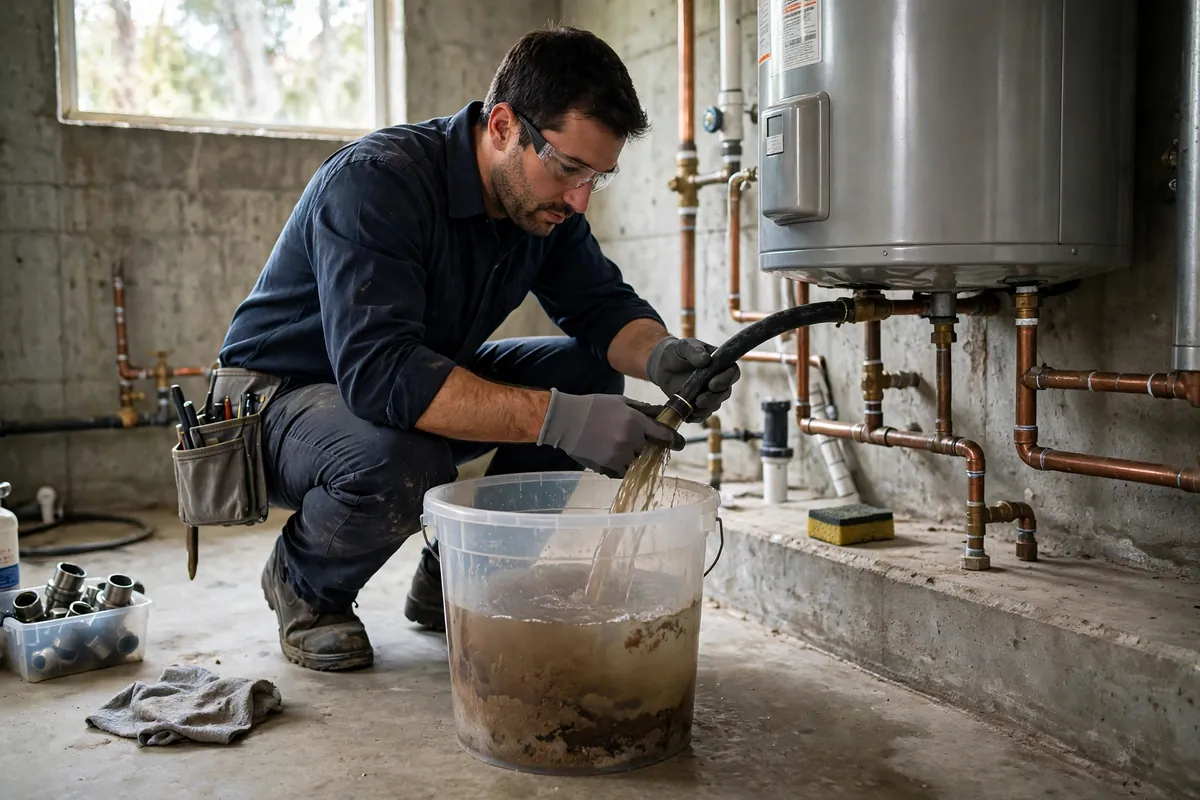
Where Clarksville's minerals come from
Middle Tennessee sits on limestone bedrock, and Clarksville's water — sourced from the Cumberland River system and local supplies — carries dissolved calcium and magnesium with it. Those minerals are not a contamination problem; they are a geology problem. They show up as white crust on faucets, spots on dishes, soap scum in showers, and, inside a water heater, as sediment in tanks and scale in tankless heat exchangers. Third-party water-quality reports vary in the exact hardness figures they quote for Clarksville, so this guide does not rely on a single number — the effects below are what matters, and they are consistent across sources.
What minerals do to each heater type
In a tank, minerals settle as sediment on the tank floor, insulating the water from the burner or element, forcing longer run times, producing popping noises, and burying the lower element. In a tankless unit, minerals coat the narrow heat-exchanger passages, restricting flow until the unit overheats and throws an error code. In a hybrid, scale adds to the same problems plus filter and condensate load. The mechanism differs; the remedy — regular flushing or descaling — is the same.
Signs your home's mineral load is high
White crust around faucets and showerheads, rapid soap-scum buildup, cloudy dishes, popping tank noises, tankless error codes, and elements failing repeatedly. If several of those appear together, your heater's maintenance interval should be at the frequent end of the range, not the relaxed end.
Softeners and filtration: what they can and cannot do
A water softener reduces calcium and magnesium before they reach the heater, which slows sediment and scale formation and can stretch flushing intervals. It does not repair a tank that is already corroded, cure sulphur-bacteria odour by itself, or remove every water-quality concern. Whole-home filtration addresses different contaminants depending on the media used. We explain the options and their limits, and we refer water-treatment decisions to treatment specialists where the question is about drinking-water quality rather than heater protection — a softener is a heater-protection decision first, and a water-quality decision second.
The maintenance answer, regardless
Softener or not, annual flushing (tank) or descaling (tankless) remains the baseline in Clarksville. A softener changes the interval; it does not eliminate maintenance. See our maintenance checklist and flushing schedule for the practical version of this guide.